Choosing a variable frequency drive (Wolong VFD) doesn't have to feel like deciphering a motor nameplate in the dark. Get it right, and you cut energy costs, extend equipment life, and achieve precise speed control. Get it wrong, and you're looking at nuisance trips, fried motors, and maintenance headaches that follow you for years.
Here's the honest truth: most VFD misapplications come down to a handful of fixable mistakes. This guide walks you through seven practical selection steps, using the Wolong VFD line as our working example. You'll learn how to select a VFD by focusing on load type, full-load current, duty cycle, and environment—not just horsepower.
Load type first — Variable torque loads (pumps, fans) allow downsizing; constant torque loads (conveyors, compressors) don't.
Match FLA, not just HP — Full-load amps from the motor nameplate drive your VFD rating. HP alone is a trap.
Overload class matters — 120% light duty vs. 150% for 60 seconds heavy duty changes the frame size you buy.
Control method follows application — V/f for centrifugal loads, sensorless vector for general machinery, closed-loop vector for precision torque.
Environment dictates hardware — Ambient temperature derates the drive; IP20 works in clean panels, IP54 buys you protection on the plant floor.
Communication is non-negotiable — Confirm Modbus RTU, PROFIBUS, PROFINET, or EtherCAT support before you install, not after.
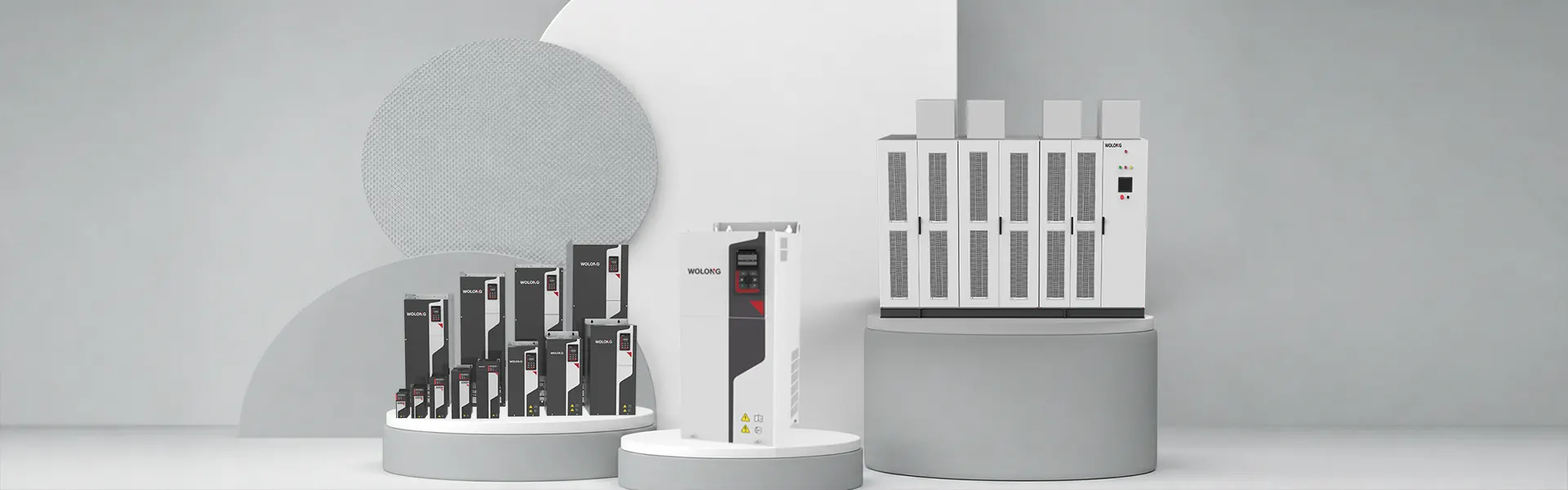
Manufactured by Wolong—one of the world's largest industrial motor and drive manufacturers—the Wolong VFD family spans general-purpose, fan/pump-specific, and vector-control models across 0.75–500 kW. We'll reference them throughout, so you can see exactly where your application fits.

A variable frequency drive is an electronic power converter that controls the speed and torque of an AC induction motor. Instead of running the motor at a fixed line frequency (50 or 60 Hz), the VFD adjusts both frequency and voltage on the fly, letting the motor run at exactly the speed your process needs.
How it works — three stages inside the box:
Rectifier — Converts incoming AC line power to DC.
DC bus — Smooths and stores that DC energy using capacitors.
Inverter — Switches the DC back to AC at adjustable frequency and voltage using IGBTs (insulated-gate bipolar transistors).
This rectifier-DC bus-inverter architecture is the core of every VFD on the market, Wolong included. But what you do with that architecture determines the value you capture.
Why does it matter? Two words: control and savings.
Mechanical speed control—throttling valves, damper vanes, gearboxes—wastes energy because the motor runs at full speed whether you need it or not. A VFD matches motor speed to actual demand. For a centrifugal pump running at 80% speed, that's roughly 50% less energy draw, because power follows the cube of speed.
You also get soft starting. Instead of a sudden inrush current that strains the motor and mechanical drivetrain, the VFD ramps the motor up gradually. Less heat, less mechanical shock, longer belt and bearing life.
Add built-in PID control for pressure or flow regulation, and a VFD becomes not just a speed controller, but a process controller—for fans, pumps, compressors, and automated production lines. That's the category. Wolong builds drives for precisely these jobs—industrial-grade units engineered around real-world applications, backed by a global manufacturer with decades of motor and drive experience.
Selecting a VFD is not about matching the motor's nameplate horsepower; it is about matching the electrical, mechanical, and environmental demands of the entire drive system. Below are the seven decisive parameters, with typical magnitudes and selection logic for each.
The very first question to answer is whether your application requires constant torque or variable torque. This single classification determines whether you can downsize the VFD, and how aggressively you can apply energy-saving features.
Variable torque loads — centrifugal pumps and fans—follow the Affinity Laws: torque rises as the square of speed, and power as the cube. At 50% speed, a fan only requires roughly 12.5% of full-speed power. This makes them ideal for energy-saving VFDs, which can typically be downsized by one frame size relative to the motor's full rating.
Constant torque loads — conveyors, crushers, extruders, mixers, and hoists—draw the same torque at low speed as at full speed. A 50%-speed conveyor still requires full belt tension. These loads demand a VFD rated at or above motor FLA, with no downsizing allowance.
Selection Check: If you are driving a centrifugal fan or pump, a V/f-controlled, fan/pump-specific VFD (e.g., Wolong's Fan/Pump-Specific series) provides sufficient torque, with integrated PID and energy-optimizing curves. If you are driving a conveyor, crusher, or mixer, choose a general-purpose or vector-control VFD rated for 100% continuous torque down to 1–2 Hz.
Never size a VFD by motor shaft power alone. The VFD's output current rating must equal or exceed the motor's full-load amperage (FLA) drawn at rated voltage. Because motors of the same kW can have different FLA values at different voltages (e.g., 230V vs. 460V), current is the single non-negotiable specification.
Practical rule: The VFD continuous output current must be ≥ the motor FLA stamped on the nameplate.
kW-to-HP conversion: For squirrel-cage induction motors, 1 HP ≈ 0.746 kW. More useful is the inverse: a 15 kW motor is approximately 20 HP, and its FLA at 460V is roughly 27 A; the same motor at 230V draws around 54 A.
Never use the motor's "rated kW" to skip measuring FLA. Two 30 kW motors from different manufacturers can differ by 3–5% in FLA due to efficiency and design class—a margin that could cause nuisance overtrips under continuous load.
Selection Check: When consulting a VFD datasheet, match the "rated output current" column—not the kW column—against your motor's FLA. Verify whether the VFD's overload curve (Step 4) can support your application's peak demand.
The VFD's input voltage must match the available plant supply. Mismatches cause immediate undervoltage or overvoltage trips and shorten DC-link capacitor life. Confirm both voltage magnitude and phase count before purchase.
Low-voltage 3-phase applications (most common): 380–460V AC, ±10%. Standard industrial supply in North America is 460V; in Europe and Asia it is 380–400V. VFDs are typically rated for a "3-phase, 380–480V" input window to span both.
Low-voltage 1-phase input: For small machines (< 2.2 kW / 3 HP) where only single-phase supply is available, many manufacturers offer "1-phase in, 3-phase out" models.
Medium voltage (690V): Some mining or marine applications use 690V. Select a dedicated 690V-rated VFD frame; do not use step-up transformers for power drive applications.
Selection Check: Confirm plant actual line voltage with a multimeter—nameplate switchgear settings are frequently inconsistent with real feed voltage.
Every VFD has two continuous duty ratings, expressed as percentage of nominal output current for a specified duration. Selecting the wrong overload class is the #1 cause of VFD failures in constant torque applications.
Light duty (variable torque): 110–120% rated current for 60 seconds, once every 10–15 minutes. Acceptable for pumps and fans because they rarely exceed base load and never need starting torque beyond 100%.
Heavy duty (constant torque): 150% rated current for 60 seconds. Essential for conveyors with jammed loads, crushers with cold-start friction, centrifuges, and extruders. The motor draws 150% current for up to a minute to break inertia.
The VFD's kW rating changes depending on duty class. A "37 kW heavy-duty" VFD is often the same physical frame as a "45 kW light-duty" VFD. Failing to declare your application class results in either wasted cost (oversizing) or nuisance thermal trips (undersizing).
Selection Check: For rotary crushers, drum mixers, or positive-displacement pumps, explicitly communicate your overload profile so the manufacturer selects the heavy-duty column during configuration.
The control algorithm determines torque accuracy at low speed, speed regulation precision, and dynamic response. Choosing the wrong method leads to either unnecessary cost (over-specified) or poor performance (under-specified).
V/f (Volts per Hertz): Output voltage rises proportionally with frequency. Simple, low-cost, and adequate for fans, pumps, and blowers. Speed regulation is typically ±1% of base speed. Do not use V/f on loads requiring high starting torque (>120%) or precise speed holding under sudden load changes.
Sensorless Vector Control (open-loop vector): Estimates motor flux and torque using an internal motor model—no encoder required. Provides 150% starting torque down to 0.5 Hz and speed regulation of ±0.5%. Use for general conveyors, mixers, crushers, and textile machines.
Closed-Loop Vector Control (with encoder): Uses a pulse encoder for real-time feedback. Achieves ±0.01% speed regulation and up to 200% torque at zero speed—essential for hoists, elevators, turret winders, and precision machining spindles.
Selection Check: Wolong's product segmentation directly maps to these algorithms: Fan/Pump-specific models run V/f-only; General-Purpose models offer built-in V/f + sensorless vector; Vector-Control models support closed-loop operation with encoder feedback card. For a crane/hoist retrofit, you need the closed-loop vector model; for a water booster pump, V/f is sufficient and more cost-effective.
Heat, dust, humidity, and altitude physically degrade VFD components. The VFD's cooling design and protection class must match the installed environment—or its rated output current must be mathematically reduced (derated).
Ambient temperature & derating: Below 40 °C, most VFDs run at 100% load. Above 40 °C, derate output current by approximately 2% per °C up to a maximum of 50 °C. In a 50 °C pump room, a 45 kW VFD may only safely deliver ~38 kW.
IP rating: IP20 (open chassis) requires installation inside an electrical cabinet. IP54 (gasketed, dust-tight, splash-resistant) allows standalone mounting directly on the machine in dusty, humid, or washdown environments (flour mills, textile dyeing, wastewater pumping stations).
Humidity & condensation: Unheated installations below the dew point risk condensation on the DC bus. Specify anti-condensation heaters if the VFD will sit idle in a humid environment.
Selection Check: When ambient temperature exceeds 40 °C at a cement plant or steel mill installation, request the manufacturer's derating chart for your selected frame size and calculate the continuous permissible motor kW before finalizing the order.
Whether for SCADA, PLC, or BMS integration, the VFD must speak the plant's fieldbus language. A mismatch can cause weeks of retrofit wiring.
Industrial Ethernet: Modbus TCP and PROFINET are common for modernization; EtherCAT is preferred in high-speed packaging or printing machines (cycle times under 1 ms).
Serial fieldbus: Modbus RTU (RS-485) is the de facto standard, present in ≥80% of existing installations. Built-in RS-485 is standard on most VFDs.
Process fieldbus: PROFIBUS-DP remains widespread in European process plants. DeviceNet appears in North American automotive; CANopen is common on mobile equipment.
Hardware I/O fallback: Discrete/analog I/O (4–20 mA speed reference, status relays) always works—but offers no diagnostics data acquisition.
Selection Check: Wolong VFDs typically include standard RS-485 ports supporting Modbus RTU, with optional plug-in communication cards for PROFIBUS-DP, PROFINET, EtherCAT, and DeviceNet. When ordering, specify "with PROFINET option card" explicitly—retrofitting after delivery costs additional labor. Confirm protocol card compatibility with your selected series and frame size.
Mistake 1: Sizing by motor horsepower only, ignoring full-load amperage (FLA). Motor nameplates list FLA at rated voltage—two motors with the same kW can draw very different currents depending on efficiency class and manufacturer. Correct approach: Always match the VFD's rated output current to the motor's FLA, and confirm the VFD's continuous current rating exceeds that FLA at the applied input voltage.
Mistake 2: Overlooking low-speed cooling failure on self-ventilated motors. Standard Totally Enclosed Fan-Cooled (TEFC) motors rely on a shaft-mounted fan. Below 30–40% rated speed, airflow drops sharply and the motor can overheat even when VFD current is within limits. Correct approach: For continuous low-speed operation below half rated speed, specify a separately force-ventilated motor or derate the motor/VFD combination accordingly.
Mistake 3: Undersizing overload capability for starting or shock loads. Selecting a VFD with only 120% overload for a crusher, hoist, or compressor that demands 150% torque during ramp-up will trigger nuisance overcurrent trips. Correct approach: Identify the overload class—Light Duty (typically 120% for 60s) vs. Heavy Duty (typically 150% for 60s)—and for constant-torque loads, size the VFD to the Heavy Duty rating.
Mistake 4: Ignoring harmonic impact on the incoming power supply. VFDs draw non-sinusoidal current, generating harmonic distortion that can overheat transformers, trip nuisance breakers, and interfere with sensitive equipment on the same bus. Correct approach: For larger drives or weak supply networks, specify VFDs with built-in DC link chokes, add external line reactors, or verify if an active harmonic filter is required—Wolong VFDs above 22 kW include DC chokes as standard.
Centrifugal pumps follow the affinity laws: torque rises with the square of speed, power with the cube. Between 50–100% speed, power demand drops dramatically—often to just 12% of rated at half speed. Selection points: Choose a V/f control unit with built-in PID for closed-loop pressure or level control; verify the drive can operate continuously at low speeds without motor overheating. A dedicated energy-saving drive is ideal—Wolong Fan/Pump-Specific Series offers downsized current ratings and integrated PID, making it the cost-effective matchfor centrifugal pump duty.
Like pumps, centrifugal fans present a variable-torque load. Axial fans have a slightly different curve but still offer substantial savings at reduced speed. Selection points: Confirm static pressure at zero flow—if the fan can operate at a closed damper, the VFD can be downsized against the motor FLA; ensure the drive handles the fan's inertia during coast-down without DC-bus overvoltage. Wolong Fan/Pump-Specific Series is again the first choice, but if the fan must start against high inertia or operate across a wide speed range below 20%, step up to the General-Purpose Series with sensorless vector control for stable low-speed torque.
Reciprocating and screw compressors demand constant torque across the speed range—and startup against full system pressure requires 150% or higher torque momentarily. Selection points: Size the VFD for the motor's FLA at Heavy Duty rating (150% for 60s); confirm the drive provides adequate starting torque without a bypass contactor if soft starting is the goal. For screw compressors with internal oil pumps and pressure differentials, use the rated motor FLA—never downsize. Wolong General-Purpose VFD (V/f or sensorless vector) covers most compressor applications up to 500 kW; for high-pressure or cyclic duty, a Vector-Control Series drive provides more precise speed regulation under fluctuating load.
Conveyors run at constant torque from zero to rated speed—often with heavy breakaway torque needed to start a loaded belt. Selection points: Verify the VFD delivers full rated torque at low speed (below 5 Hz) without derating; consider that long conveyors with high inertia may require a braking resistor or regenerative unit during deceleration. Correct choice: A Wolong Vector-Control Series VFD—with closed-loop vector control and encoder feedback—maintains full torque at zero speed, essential for positioning and controlled starts under load. For simpler, fixed-speed conveyors, the General-Purpose Series with sensorless vector control provides adequate torque down to 1 Hz at a lower cost.
Start with the motor nameplate FLA—the VFD's rated output current must be greater than or equal to the motor FLA at the applied voltage. Match the VFD input voltage to your supply (230V, 460V, or 690V), then consider the load type and duty cycle: if variable-torque (fan/pump), you can downsize per VFD ratings; if constant-torque, choose Heavy Duty current rating. When in doubt, select the next larger standard VFD rating.
Yes—but with clear limits. A single VFD can run multiple motors in parallel only if all motors start and stop simultaneously and total FLA does not exceed the VFD's rated current. Individual overload protection becomes the motor starter's responsibility, not the VFD's. If you need independent start/stop or different speeds, specify individual VFDs for each motor.
A variable-torque load, like a fan or centrifugal pump, has torque demand that rises with the square of speed—so the VFD can run at a lower continuous current rating at reduced speeds. A constant-torque load, like a conveyor or compressor, needs the same torque at all speeds, requiring the VFD to maintain its rated current output across the entire speed range—hence a bulkier Heavy Duty rating. Variable-torque VFDs are cost-optimized for fan/pump duty; constant-torque (general-purpose) VFDs handle both but cannot always downsize.
Not if specified correctly. Standard TEFC motors rely on shaft-mounted fans—below ~30% rated speed, cooling airflow drops and the motor may overheat at high load. Use a separately force-ventilated motor, derate the motor for low-speed operation, or verify the manufacturer's low-speed torque curve matches your duty cycle. The VFD itself does not damage the motor; the cooling limitation does.
The VFD will operate the motor fine—but you pay unnecessary cost, and at very light loads, the drive's efficiency dips and motor magnetizing current may cause slight overheating in some cases. More critical: oversizing doesn't harm the motor or the drive. The only truly damaging mistake is undersizing—selecting a VFD with insufficient output current to handle the motor FLA plus overload requirements produces nuisance trips and can shorten drive life.
Most VFDs are rated for full output at ambient temperatures up to 40°C. Above that, output current must be derated by approximately 2% per °C up to the maximum allowable temperature (typically 50–60°C depending on model). In a hot pump room or steel mill environment, this derating can effectively reduce the usable kW of a given frame size by 15–20%. Always review the manufacturer's derating chart when installing in elevated ambient conditions.
Selecting the right VFD comes down to matching five variables—load type, motor FLA, input voltage, overload class, and ambient conditions—not just picking the cheapest option or the largest frame size. Get these right, and you gain reliable speed control, measurable energy savings, and years of trouble-free operation. Get them wrong, and you face nuisance trips, premature failure, or wasted capital. This guide's worked examples across the Wolong VFD line show that a systematic approach to this VFD sizing guide is the surest path to long-term performance.
Whether you are replacing an aging drive or specifying a new installation, applying these seven selection steps will dramatically reduce your risk of misapplication. The investment in proper variable frequency drive selection pays dividends in every subsequent year of operation.
As a global industrial VFD manufacturer, Wolong VFD brings engineering depth and application-specific thinking to every drive conversation. Whether you are running a variable-torque pump, a constant-torque compressor, or a precision automation line, the product lineup—General-Purpose, Fan/Pump-Specific, and Vector-Control series—is designed to deliver energy efficiency and load-matched reliability across demanding industrial environments.
A VFD is not a commodity purchase; it is a long-term operating decision. That confidence starts with specification. Visit https://vfdpower.com/ to explore the full range of drives, review current spec sheets, and connect with sales engineers who can confirm your motor nameplate data against the right Wolong model—so your next installation performs precisely as designed.
Contact Us
Be the first to know about our new product launches, latest blog posts and more. Founded in 1984, Wolong is a global leader in motor and drive technology, providing safe, efficient,... Any question or request?
Click below, we’ll be happy to assist. Contact Us