If your motor runs at a fixed speed and you only need a gentler start, a soft starter is the economical choice. If you need adjustable speed, process control, or energy savings on fans, pumps, and compressors, you need a variable frequency drive (VFD). This guide compares both technologies across starting performance, cost, energy use, and application fit, so you can specify the right solution the first time without overspending or underspecifying.

A soft starter is a reduced-voltage starting device. It uses thyristors (SCRs) to ramp the voltage applied to the motor over a few seconds, limiting inrush current from a typical 6–8× full-load current with direct-on-line starting down to roughly 2–4×, depending on the setting. Once the motor reaches full speed, a bypass contactor closes and the soft starter drops out of the circuit.
The key point: a soft starter controls starting only. It does not control speed, torque, or running energy consumption. It is a mature, low-maintenance technology covered by IEC 60947-4-2 (AC semiconductor motor controllers and starters).
A variable frequency drive (VFD) converts the incoming AC supply to DC and then back to AC at an adjustable voltage and frequency. Because the synchronous speed of an induction motor is proportional to frequency, a VFD can run the motor continuously anywhere from near 0% to 100% of rated speed — and with vector (field-oriented) control, it delivers rated torque even at low speed.
A modern VFD does far more than start a motor gently. It provides:
Speed and torque control for process regulation
Soft start and soft stop, which reduce inrush, mechanical stress, and water hammer
Energy savings on variable-torque loads
Built-in protection (overcurrent, overvoltage, overload, phase loss)
Safety functions such as Safe Torque Off (STO)
Communication options for PLC and SCADA integration
Power drive systems are covered by the IEC 61800 series — IEC 61800-5-1 for electrical and thermal safety, IEC 61800-3 for EMC, and IEC 61800-9-2 for the energy efficiency classification (IES) of motor systems.
| Feature | Soft Starter | VFD |
| Main function | Limits inrush current during start only | Controls speed and torque continuously |
| Speed control | None after start (fixed speed) | 0–100% adjustable |
| Typical starting current | 2–4× rated (adjustable) | 1–1.5× rated with controlled ramp |
| Running energy saving | Minimal | Significant on variable-load duty |
| Soft stop | No | Yes (reduces water hammer and shock) |
| Input harmonics | During start only | Continuous (depends on design and filtering) |
| Relative purchase cost | Lower | Higher (but falling) |
| Typical duty | Fixed-speed motors | Variable-flow pumps, fans, compressors, precision processes |
A soft starter is often the better buy when:
The motor always runs at full speed. Conveyors, crushers, agitators, and fixed-speed pumps or fans need controlled starting, not speed variation.
Grid capacity is the constraint. If direct-on-line starting would cause unacceptable voltage dips, a soft starter solves the problem at the lowest cost.
The budget is tight. At the same power rating, a soft starter typically costs substantially less than a VFD, and commissioning is simpler.
Mechanical stress matters. Ramped starting extends the life of couplings, belts, and gearboxes without the cost of full drive control.
Choose a VFD when the process needs more than a gentle start:
Flow, pressure, or speed must vary. Pumps, fans, blowers, and compressors are the classic case.
Energy cost is significant. A VFD is the most practical way to capture affinity-law savings (below).
Soft stop is required. Controlled deceleration prevents water hammer in pipelines and shock in material handling.
The application needs automation. PID control, remote setpoints, multi-speed presets, and fieldbus communication all require a drive.
You run a permanent magnet synchronous motor (PMSM). PMSM motors require a drive; they cannot be started across the line.
If your application fits these conditions, start with our VFD selection guide to shortlist the right drive series and rating.
For centrifugal pumps and fans, the affinity laws state that flow is proportional to speed, while shaft power is proportional to the cube of speed. Run the machine at 80% speed and the ideal shaft power drops to about 51% of full load — the reason VFD retrofits on fans and pumps so often pay back quickly.
| Motor speed (% of rated) | Ideal shaft power (% of full load) |
| 100% | 100% |
| 90% | 72.9% |
| 80% | 51.2% |
| 70% | 34.3% |
| 60% | 21.6% |
Example: a pump that runs at 80% speed for most of the day draws only about half the shaft power of a full-speed, throttled pump. In many installations we see payback periods of one to three years, depending on duty cycle and energy tariffs.
Two honest caveats. First, these figures are the idealized affinity-law relationship and exclude motor, drive, and hydraulic losses. Second, on constant-torque loads such as conveyors and mixers the savings shrink sharply. Energy saving should be matched to the real load profile, not to a headline percentage. For real-world cases across industries, see our VFD applications pages.
The purchase price tells only part of the story:
First cost: soft starter wins. At equal rating, expect a meaningful price gap, and the smaller footprint and simpler installation add to the saving.
Running cost: VFD wins on variable-speed duty. Cutting fan or pump power by 30–50% usually dwarfs the initial price difference within a year or two.
Maintenance: both are solid-state and low-maintenance; a VFD adds diagnostics and condition monitoring, which reduces downtime on critical machines.
Total cost of ownership: for fixed-speed machines, the soft starter is usually the better asset; for variable-duty machines, the VFD usually wins over the equipment's life.
Harmonics and EMC. A VFD draws harmonic current, so plan for input harmonics and follow IEC 61800-3. Line reactors and passive or active filters handle most cases — and some new-generation drives ship with inherently lower harmonics and high power factor.
Motor insulation and cable length. Fast switching and long motor cables can stress motor insulation. For long runs, use screened cables and, where needed, output filters; the guidance in IEC 60034-17 and IEC 61800-5-1 applies.
Safety. If the application needs a safe torque-off function, look for a drive with built-in STO (per IEC 61800-5-2) rather than adding external hardware.
Environment. Both devices derate at high altitude and temperature; check IP ratings and cooling arrangements for dusty or humid sites.
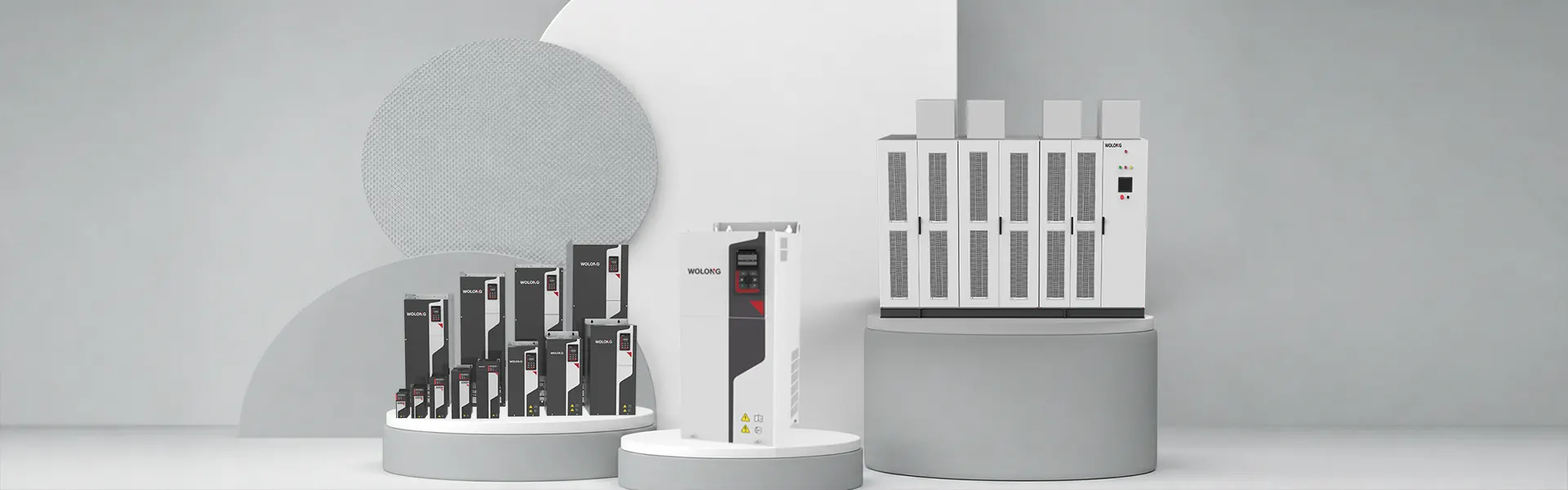
Wolong Electric Drive Group has more than four decades of drive manufacturing experience, with manufacturing bases and service support around the world. Our low-voltage VFD range — the WD200 and WD400 series — controls both induction and permanent-magnet synchronous motors, offers built-in STO, and carries CE, UL, and EAC certification. The WD400 series combines vector control, high low-speed torque, and low input harmonics in one compact package, with drive efficiency up to 98%. For larger installations, the medium-voltage VFD WD5100 series covers applications from 280 kVA up to 2,500 kVA.
Wolong VFDs are working today in cement plants, mines, thermal power stations, petrochemical facilities, and water treatment plants — the industries where reliable variable speed pays for itself.
Not in the running state. A soft starter only improves the starting transient; once bypassed, the motor draws the same power as a direct-on-line start at full speed. On variable-flow loads, real running savings come only from a VFD.
In almost every case, yes — a VFD provides the same controlled ramp plus speed control, soft stop, and protection. Before retrofitting, confirm the motor is suitable for drive operation (insulation class and inverter-duty rating). See our drive FAQs for related questions.
Usually not. If the flow never changes, a fixed-speed machine with a soft starter is typically the lower-cost answer. The value of a VFD grows with the amount of time the machine runs below full speed.
Not sure whether a soft starter or a VFD fits your application? Send us your motor nameplate data (kW, voltage, current, speed, duty) and a short description of the load — our application engineers will come back with a recommendation and, if a drive is the right answer, a matched Wolong VFD proposal.
Contact Us
Be the first to know about our new product launches, latest blog posts and more. Founded in 1984, Wolong is a global leader in motor and drive technology, providing safe, efficient,... Any question or request?
Click below, we’ll be happy to assist. Contact Us